
Should You Move Out During a Renovation? What to Know Before You Decide
Most homeowners approaching a renovation, whether it's their first or their fifth, believe they'll be okay living through "a little bit of dust."
Can you live at home during a renovation? Sometimes. Whether you should is a different question, and for a substantial renovation, our answer is usually no. If you have somewhere else to go, moving out gives the team control of the site and gives you distance from the noise, dust and daily disruption. If you can't leave for the whole project, plan to leave during the most invasive phases. And if you're staying, make that decision before the project is bid, so the plan and the price reflect it.
The decision reaches well beyond personal comfort. It affects how the work is sequenced, how the site is protected, when and how certain work can take place, and ultimately how efficiently the project moves.
It also means experiencing construction from a very different perspective.
The Phases Worth Leaving For
Not every phase is equally disruptive. Once demolition and heavy construction are behind you, much of a renovation becomes easier to live with. A few stages, though, are hard to live through no matter how well the site is run. We think of them as a renovation's blackout periods.
Demolition. Demolition is loud, disruptive and dusty by nature. Even with proper site protection and containment, this is not a phase we recommend trying to live alongside.
Rough systems. Plumbing, electrical, HVAC and other rough work mean open walls, temporary utility shutoffs and a lot of movement through the house. Depending on the scope, essential parts of the home may not work normally for a while.
Drywall, patching and sanding. If you've never lived with drywall dust, it's hard to describe how far it travels. Containment helps enormously, but the finest dust has a way of reaching well beyond the work area.
Painting and finishing. Painting may sound relatively mild compared with demolition, but substantial portions of the home need to be protected and closed off while it’s underway, and ventilation and drying times add their own limits.
Floor refinishing. Where floors are being sanded and refinished, access, dust, fumes and curing time make those areas impractical to use.
If you can't be away for the whole project, these are the stretches to plan temporary accommodation around.
Construction Dust Is Not Household Dust
Dust is the thing almost everyone underestimates.
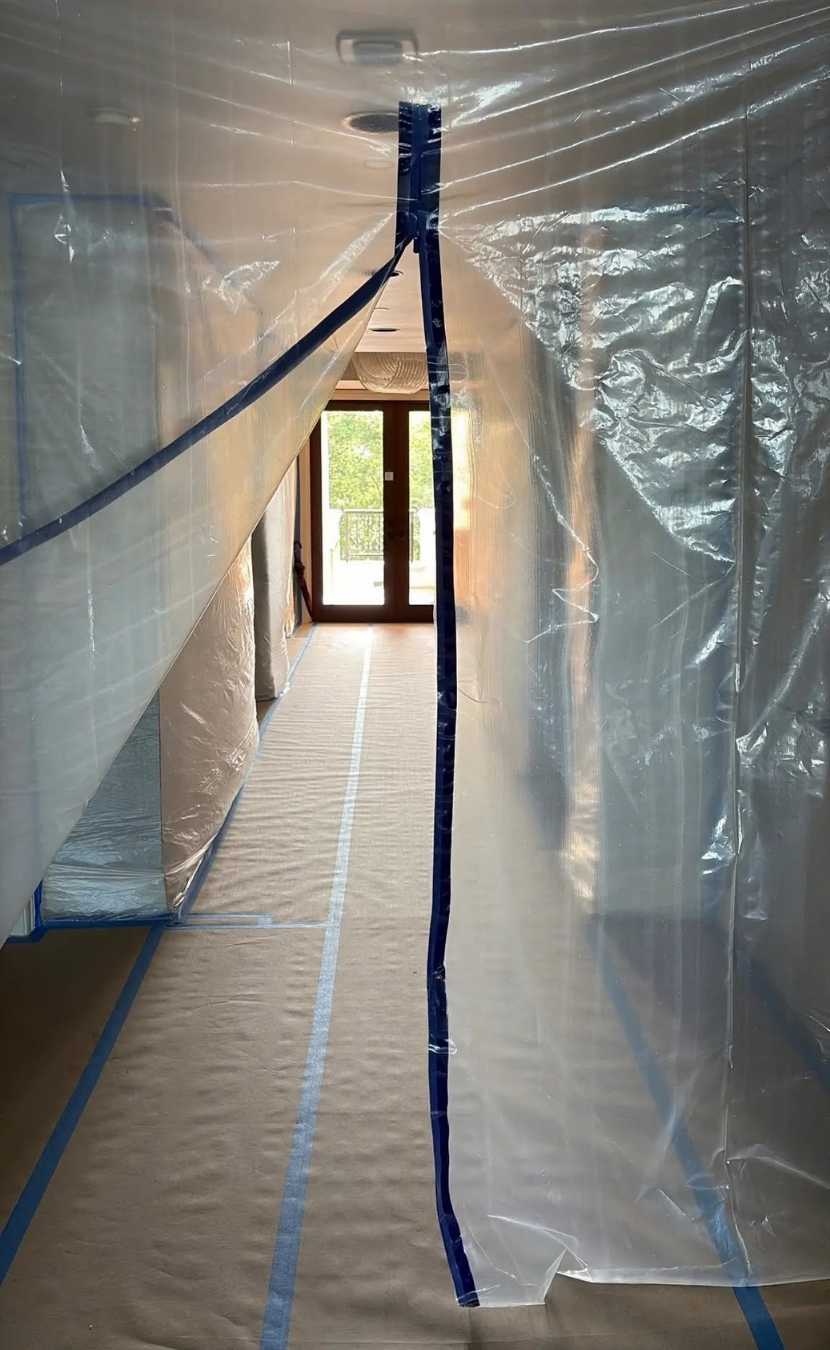
A well-run site will have protection, containment and a cleaning routine, and those measures make an enormous difference. What they do is control dust, not eliminate it. Fine particles work their way through gaps, gather around doorways and settle in rooms you thought were sealed off. Clothes in a closed closet can come out with a light layer on them. Even after the final clean, dust tends to keep surfacing for a while.
If you're planning to remain in the home, discuss dust containment with your contractor before construction begins about which areas can realistically stay clean, how the HVAC will be handled, where barriers will go and what should leave the house altogether. Good containment makes dust manageable. It doesn't make it disappear.
We often host workshops for those looking to understand how to renovate well.
Want to stay in the know? Check out our events below.
What Changes When the Home Is Occupied
This is the part of the decision people tend to overlook. In an occupied home, the team isn't only building. They're building around a household.
Paths through the house have to stay clear. A kitchen or bathroom may need to keep working. Protection goes up, comes down and goes back up again. Work stops early so a space can be cleaned and handed back for the evening. Loud work is confined to certain hours, and there are fewer places to receive deliveries, cut materials or stage what's coming next. Each of these is a reasonable request. Together, they change how the site runs and how long things take.
Being there also means being part of the process in real time. When you watch something going in, coming out or being adjusted, questions come naturally, and over the course of a project those conversations add up.
Then there are the small problems. Every renovation has hundreds of them: a dimension that needs adjusting, an existing condition that isn't what anyone expected, two trades who need to sequence something differently. An experienced team solves these as part of the ordinary work.
When you visit a project periodically, you usually see the solution. When you live inside it, you see the problem first.
That alone can make a perfectly normal process feel far more stressful than it is. Anything that genuinely needs your input should come to you. But part of working with an experienced team is that much of the everyday problem-solving can happen without becoming part of your day.
Renovating a Condo While You Live In It
In a condo or apartment, the building has a say too. Every building sets its own rules, and they can shape a project as much as the design does.
Reservations are often the biggest factor. Elevators, loading areas and delivery times may all need to be booked in advance, and when those windows are limited, materials and crews have to move on the building's schedule rather than the project's. Parking is another. Many buildings don't provide space for contractors, so crews may spend part of the day finding outside parking and carrying tools and materials in from a distance. It sounds minor, but across weeks of construction that lost time adds up, and it shows up in the schedule.
Living in the unit during construction also means sharing hallways, elevators and walls with neighbors, and building management will expect the work to respect that.
We're used to working within building requirements, and we find it pays to understand them before the schedule is set rather than discover them once work has started.
Leave Room in the Timeline
Temporary housing also has to account for the schedule itself.
A well-managed project is carefully planned, but renovations carry variables that planning can't fully remove. Change orders happen, sometimes because a homeowner decides to add or change something, sometimes because opening a wall reveals work nobody could have seen. Permits and inspections run on their own timing. Materials, fabrication and freight can all take longer than expected.
Some of that risk can be reduced early. When finishes, fixtures and key furnishings are selected, approved and ordered before construction starts, they're far less likely to turn into delays or mid-project changes.
Still, a renovation schedule is a carefully managed plan, not a promise that everything will unfold exactly as expected months in advance. If your project is scheduled for six months, don't book housing you can't extend at six months and one day.
The Part No One Budgets For
Construction isn't pretty while it's happening. Between the renderings and the finished photographs there's a long middle stretch. Walls are open, wiring is exposed, materials are covered, the furniture is gone, and rooms that worked perfectly well can look worse than they did before you started.
Stopping by once a week, you see a room go from framing to drywall to paint. Living there, you see every stage in between, first thing in the morning and again at night. Add the noise, the dust, crews arriving early, less privacy and parts of the house closed off, and renovation fatigue sets in faster than most people expect.
Sometimes the greatest luxury temporary housing offers isn't comfort. It's distance.
Isn't Moving Out More Expensive?
It can be. Temporary housing is a real cost, especially on a longer project, and it's the most common reason people consider staying.
But staying isn't free either. Keeping a construction site partly livable means extra protection, repeated cleaning, work sequenced around the household, temporary facilities, shorter working hours and more setup and breakdown. All of that takes time and labor, and on a renovation, both show up in the budget.
It helps to think of temporary housing as part of the project budget rather than a separate personal expense. Weigh it against everything staying would require, not just the rent you'd save. Staying may still be the right decision, and moving out may cost less than it first appears. Either way, make the decision with the full picture in front of you.
The simplest way to get that picture is to ask your team directly: how would our staying in the house affect the price, the schedule and the process? The answer usually makes the choice much clearer.
If You're Staying, Say So Before the Project Is Bid
If moving out isn't an option, build that into the plan from the start, before anyone prices the work.
Occupancy is a job-site condition.
Keeping a kitchen running, pulling up protection every Friday and putting it back on Monday, cleaning certain rooms daily, working around a family's routine: all of it takes time and labor. Whatever isn't planned and priced at the beginning has a way of becoming a costly change later.
When a client plans to stay, we encourage settling these ground rules with the contractor before bidding, so everyone is pricing and planning the same project.
That framework typically covers:
Schedule
Working days and hours
Days when no work can take place
Notice required before utility shutoffs
Spaces in use
Which rooms and bathrooms need to stay working
Temporary kitchen or bathroom arrangements
Areas that are completely off-limits
Protection and cleaning
Protection for floors, walls, elevators and furniture
Whether protection stays in place or comes up periodically
How the HVAC runs and how dust is contained
Daily and weekly cleanup expectations
Shoe or bootie policies where appropriate
Site logistics
Worker entrances and routes through the home
Delivery windows and where materials are staged
Where cutting, mixing and similar work can happen
Parking, building and access requirements
Household and communication
Considerations for children and pets
Who the homeowner speaks with about day-to-day site matters
The clearer this is up front, the less anyone has to guess later. It also gives the people working in your home a clear sense of what's expected, which makes for a better working relationship on both sides.
Looking to apply this to YOUR renovation project?
Download our RENOVATION checklist by filling out the form below and
a member of our team will reach out.
Children, Pets and Working From Home
The right answer also depends on who lives in the home.
An adult deciding they can put up with a few months of inconvenience is in a different position from a household with young children, pets, an elderly parent or someone with mobility or respiratory concerns.
Working from home adds another layer. An office that isn't being touched won't necessarily work as an office while demolition or tile cutting is happening on the other side of the wall.
None of this means you can't stay. It means you should have a realistic conversation about what daily life will actually look like. The same principle that guides the design applies to planning the construction: the home has to work for the people who live in it.
What You're Coming Home To
Moving out raises a practical question: what happens to everything inside? Furniture, art and belongings need a plan for removal, protection or storage, and that plan works best when it's coordinated with the construction schedule rather than improvised around it. It's also worth deciding early what you'll be returning to. A home that's construction-clean but empty is a very different arrival from one that's finished, furnished and ready to live in. When furnishings, procurement and installation are planned alongside the renovation, moving back in marks the end of the project, not the start of another one.
So, Should You Move Out During Your Renovation?
For a substantial renovation, our view is simple. If you can live elsewhere, do. If you can't be away for the whole project, be away for the most disruptive phases. And if you're staying throughout, decide early, so the plan, the price and the rules of the site all reflect it.
Once construction begins, you aren't just living through a renovation. You're living on a job site.